A question that comes up frequently is "How do I increase my followers or fans or subscribers?"
Several people asked that question during my MarketingProfs online seminar on How to Manage Your Reputation in a Social World as well as during my Coverings 2011 presentations.
The easy answer is that you can increase the number of followers, fans and subscribers by engaging with them. Say thank you; get to know them; acknowledge them; be respectful; offer them content that addresses questions they have about your product or service. Imagine if your fans, followers and subscribers came by your office, store or home. Wouldn't you greet them and invite them in for conversation? It's the same online.
At the same time, I caution against 'get rich quick' schemes that guarantee you 1000s of followers and fans overnight. The result of such a strategy may be good for your ego, but it will not deliver quality of interaction, the possibility of building credibility online and the opportunity to establish long term business relationships over the long haul. It will, however, offer you considerable spam and irrelevant messages. Much better to build your base of fans, followers and subscribers consistently over time as a result of exchanging value and meaning.
Given the relevance of the topic, I thought it would be valuable to share with you other perspectives on how to increase your followers, fans and subscribers.
Social Media Examiner has just published 17 Ways to Grow Your Blog From Top Bloggers which includes perspectives from some of the best bloggers around on How To Grow Your Blog:
Mitch Joel recommends being active in other communities first.
Michael Brandvold says to write about what you love,
Mark Schaefer suggests writing insanely great content.
Mark Robertson recommends that you answer questions for your audience.
Danny Brown says to offer real value.
Mike McGrail recommends that you be there for your readers.
Deb Ng says to say something new.
Gini Dietrich states make your readers feel good.
Fransisco Rosales suggests respecting your audience.
Stanford Smith says to focus on evergreen content.
Tom Webster recommends that you know your goals and stick to them.
Lee Odden urges that you deliver as promised.
Jay Dolan states that you should give each reader opportunities to interact with you.
Jason Keath says to ask for subscriptions at the end of your article.
Mack Collier recommends placing your subscriber box at the top.
Ricardo Bueno urges that you offer a benefit.
Kristi Hines recommends letting people follow you in the way they prefer.
Do you detect a theme?
As it relates to Twitter, you may enjoy The Drew Blog and 7 Crazy Ways to Increase Your Followers on Twitter. My favorite? "Bribe them with prizes." That is sure to deliver deep loyalty! And, assuming that a Charlie Sheen type follower base is the ideal target market for your business, you might learn something from How Charlie Sheen Got 1 Million Twitter Followers in 24 Hours (and what we can learn from it)... The most critical lesson in my mind is that you produce engaging content which means that you need to be paying attention to what matters to your followers...
As it relates to Facebook, this article titled Promote Your Business With Facebook - Effective Strategies will offer you good ideas.
What have you found most effective for increasing your fans, followers and subscribers?
Thanks for reading. If you liked this post, please consider subscribing!
Visit Simple Marketing Now!
If you'd like to read our blog content in real time, visit Simple Marketing Now directly and consider subscribing to Content Talks Business.
Thursday, March 24, 2011
Tuesday, March 22, 2011
BRITE Conference: Steve Rubel & 11 Digital Trends to Watch in 2011
As I promised in BRITE Conference 2011: Highlights, here are my notes from Steve Rubel's presentation on the 11 Digital Trends to Watch in 2011.By the way, this year's Edelman digital trends represents a collaborative mashup between Steve Rubel's and David Armano's views of the future. Since both are hugely talented and marvelously immersed in the digital world, the trends are definitely worth internalizing...
The 11 digital trends to watch in 2011 include:
Attentionomics – Marketers begin to realize the value of attention and not just reach in driving conversion. Attention becomes gold as we are time constrained and on the receiving end of too much input. Let's face it, reach is an empty metric. Better to go where the conversation is taking place. Visuals are underutilized. Best to leverage data and utility."Scale your surfaces with digital embassies." Think about day parts and when is best to engage with customers. See Rubel's Attentionomics: Captivating Attention int he Age of Content Decay for additional perspective on this trend.
Digital Curation – The plethora of content will give rise to digital curators who can separate art from junk. I personally love the notion of digital curation and consider it powerful for those with knowledge. It's an opportunity to separate the art from the junk. Every brand can become a curator and own a specific knowledge zone. Editorializing, framing the issue, makes it collaborative and social.
Developer Engagement – Marketers typically don’t try to court developers, but that’s all about to change. You see, developers drive innovation. If you make content and data available to them, you have a greater chance of creating an ecosystem. If you help developers win by making assets available, building APIs, they will adopt your creations. See Rubel's Fish Where the Developers Are (2011 DIGITAL TRENDS PART I)
Transmedia Storytelling – If there’s one constant it’s that humans crave stories. Technology creates new expectations. Yes. Humans love stories. Narratives are being consumed in less linear and more disconnected ways [e.g., Twitter via links and Facebook via video and pictures]. Therefore, help readers connect the dots. Let employees tell stories. Encourage handcrafted content for each venue. Example: Zappos.
Thought Leadership – Companies recognize they must activate credible individual expert voices who can create content. Companies that propagate new ideas generate trust. They engage in meaningful conversation. Therefore, build expert hub for internal subject matter experts; equip them with the tools to tell stories and fan them out across a cloverleaf of media.
The Integration Economy – Social media efforts can no longer exist in fragmented, non-formal initiatives. They begin to integrate. Therefore, make social media a part of everyone's job. Increase collaboration across departments. Start listening; consider centralizing listening. Integrate, share intelligence across enterprises. Modify existing process and protocols so you can be ready to go.
Ubiquitous Social Computing – As competition heats up mobile devices, consumers closer to being socially connected anywhere. We will absolutely connect everywhere! We will become less dependent on PCs and more on mobile as we 'untether'. Therefore, design for digital distribution. Plan for multiple digital experiences and platforms. Optimize for mobility. Combine social sharing integration.
Location, Location, Facebook – If 2010 belonged to solely Foursquare, it’s likely that Facebook will rain on their parade in 2011. Facebook is well positioned to make location successful. Local, social, photo and mobile are being included in everything! Combine real and digital; reward with status.
Social Media Schizophrenia – Social overload is no longer a problem for tech mavens, but a broader population. Overload is real and more average users will experience it. Let people self select which tools they will engage with. Make social participation effortless! Do big platforms well. Keep it simple!
Google Strikes Back – Google proves that the best way to beat Facebook & Twitter is to do what they do best: index them to pieces. Therefore, integrate paid, earned, owned and social. Go beyond keywords to think visibility. Focus on producing regional, relevant, high quality content.
Viva La Social Web Site – Businesses realize that integrating social functionality into their existing web sites is what users now expect. Explain benefits in human language. Bring social into website and website into social.
Here's the full presentation:
Thursday, March 17, 2011
Managing Your Social Reputation: Highlights
I can't thank you enough for making my inaugural MarketingProfs online seminar titled "Managing Your Reputation in a Social World" so successful! I was blown away by the enthusiasm that seminar participants expressed in the online chat as well as the #MProfsPRO Twitter chat and thoroughly enjoyed the questions - not to mention the awesome feedback!
Several similar questions have come up this week during my Coverings seminars and I plan to address them in a separate post.
[Click on this link for the #MProfsPRO Twitter chat transcript for the event.]
Special thanks to my friends at MarketingProfs - Kathy Bushman, Anne Schweitzer and Valerie Witt - for their expert guidance.
If you missed the presentation you can still experience it via the seminar recording of Managing Your Reputation in a Social World. Be sure to listen through to the end since the Q&A session conversation was lively.
I consider the topic of reputation management fascinating - not to mention hugely relevant - and thought I would recap here the links that I shared in my presentation.
, urged us to "listen first, sell second."
The benefits of participating in social media:
About conflict in the marketplace:
Extremes in the marketplace:
Age of Conversation Opportunities
What About Negative Feedback?
Guidelines:
Best,
C.B.
Several similar questions have come up this week during my Coverings seminars and I plan to address them in a separate post.
[Click on this link for the #MProfsPRO Twitter chat transcript for the event.]
Special thanks to my friends at MarketingProfs - Kathy Bushman, Anne Schweitzer and Valerie Witt - for their expert guidance.
If you missed the presentation you can still experience it via the seminar recording of Managing Your Reputation in a Social World. Be sure to listen through to the end since the Q&A session conversation was lively.
I consider the topic of reputation management fascinating - not to mention hugely relevant - and thought I would recap here the links that I shared in my presentation.
Managing Your Reputation in a Social World - References
I referred several times to the Socialnomics Social Media Revolution Refresh video. It's packed with good data and perspective, not least of which is a reference to Dale Carnegie who, as far back as 1936 with his bestseller How To Win Friends and Influence PeopleThe benefits of participating in social media:
- Charlene Li and the Altimeter group study: Deep brand engagement correlates to financial performance
- Check out the Real-time marketing and PR webinar by the wonderful David Meerman Scott.
- From eMarketer 121016: Social Media Increases Small Business Exposure
- I love these charts from Hubspot: Study Shows Small Businesses That Blog Get 55% More Website Visitors.
About conflict in the marketplace:
- Retail Experience Issues and Paco Underhill
- Financial Marketers: Get In Touch With Your Feminine Side - Wells Fargo research
- Don't miss The Break Up. I'm amazed that this was released in 2007 and yet remains so relevant.
- Digital Visibility: The Reason Behind Content Marketing
- The Network in Your Customer by David Rogers
- [Definitely check out Sheena Iyengar & the Power of Choice.]
Extremes in the marketplace:
Age of Conversation Opportunities
- Fiskateers: Fiskars: 360 Years Young & Innovating with Customers and CMO 2.0 Conversation About The Fiskateers.
- CME group / notes from MProfs Digital Mixer 2009 - Twitter Success Stories
- Sandy Carter Integrates Social Media Into The Marketing Mix
What About Negative Feedback?
- "Sorry Pumpkin" - The Labcorp Saga Continues
- Reference: AdAge “The Right Way to Make Your Social Media Mea Culpa” 5/10/10
- Boeing's Social-Media Lesson
- [Story related to Nestle: 7 social media lessons from Nestle's Facebook missteps and When Social Goes Wrong: Customer Relations Fiascos]
- United Breaks Guitars - also check out Dave Carrol's website
- HBS Cases: United Breaks Guitars
- How Do I? Deal With Negative Comments
Guidelines:
- IBM Social Computing guidelines
- [Related story: Why You Need a Social Media Policy]
- How Do I? Start With Social Media Guidelines
- Interview with Kodak's Chief Listening Officer
- [I love this story about how Staples Keeps Customers 'Following' on Twitter because it is paying attention to customers and thinking about the service implications.]
- From AdAge: Listen Up! Six Things You Need to Know About Social Listening. Note references to listening for intelligence, customer service and action.
- Develop a plan to deal with complaining tweets, posts
- Five Tools for Tracking, Measuring, and Evaluating Your Personal Brand Online
- Defeating the Dark Side of Social Networking
- 'I Hate My Room," The Traveler Tweeted. Ka-Boom! An Upgrade!
- Scenario Planning: Kami Huyse's 3 Rs of Crisis Management
- Beware snark attacks - Connie Reece from Every Dot Connects
- Social Media Response Chart, Ohio State Medical Center
- Dealing with Haters, Potty Mouths on your Newsroom Facebook Page
- 6 Reasons To Not Fear Negative Reviews
- [Related story: Setting the record straight on online reviews: An interview with Bazaarvoice's Ian Greenleigh from Mack Collier.]
- Social Media Explorer: 101 Social Media Stats to make your spirits bright and your head spin
- Forrester's Augie Ray: 7 Things Your Organization Must Do Because of Social Media
- 11 Unwritten Laws of Reputation Management
- Blogger Outreach: 8 Tips for Managing Brand Promoters & Detractors
Just Spotted on the subject of Managing Your Social Reputation:
- From Danny Brown, Of Comment Trolls and Flash Mobs
- Troll, Reveal Thyself on why anonymous comments should be banished
Best,
C.B.
Tuesday, March 15, 2011
Practical Simple Marketing in the News - 3/15/11
I'm off to Coverings 2011 and thought you would enjoy a less intensely packed issue of links and resources tagged #practicalmktr relating to Practical Simple Marketing In The News.
[If you are interested in the customer and retail experience, check out Flooring The Consumer with Retail Experience links #retailexp.]
Thank you for reading!
Best,
C.B.
Image credit: “#PracticalMktr” Wordle by CB Whittemore
[If you are interested in the customer and retail experience, check out Flooring The Consumer with Retail Experience links #retailexp.]
Practical Marketing Advice
- Lovely wisdom fr Sean Howard / Craphammer on Google Analytics http://ow.ly/44uDU #practicalmktr
- Search and social continue to evolve: http://ow.ly/45gHf #practicalmktr
- Outdoor advertising reinvents itself via social http://ow.ly/47E8c #practicalmktr
- Optimizing videos for bing, google search engines: inform, engage, keywords http://ow.ly/46SLo #practicalmktr
- Nice! RT @heidicohen: 10 tips 4 #socialmedia introverts http://bit.ly/eGGz5g Via SmartBlog on SocialMedia #smchat #practicalmktr
- Facebook reach and fascination: video http://ow.ly/48TUL #practicalmktr
- Must read post + comments: RT @markwschaefer: Social Media Case study: 6 ideas to get yr blog out of fog http://bit.ly/ecXk5O #practicalmktr
- Fascinating discussion about Twitter metrics happening on @blueglass by Amy Vernon http://ow.ly/48HwH #practicalmktr
- New to Twitter? Here R the 4 stages of 'getting' twitter http://ow.ly/48TRz #practicalmktr
- Integrating social and mobile is revolution not an evolution in marketing says BCG John Rose http://ow.ly/48TH7 #practicalmktr
- Have U optimized your ecommerce site, including customer reviews? http://ow.ly/48WaT #practicalmktr
Simple Marketing Inspiration
- Attn all marketers: social media is about relationships AdAge article re: social & Egypt http://ow.ly/44tWH #practicalmktr
- How social media helps companies become part of civic landscape http://ow.ly/47E3d #practicalmktr
- "There's nothing gender specific in running a business well" http://ow.ly/45gvK #practicalmktr
- The evolution of listening and social intelligence. Converseon interview http://ow.ly/47EzO #practicalmktr
- Interesting insights re: nature of social media fr Egypt revolution http://ow.ly/48V4U #practicalmktr
- It pays to be happy! FastCo article about corporate pursuit of happiness. This makes me happy http://ow.ly/48SYx #practicalmktr
- Lovely B2B perspective on social media in these links fr @dianekrose http://ow.ly/45gLi #practicalmktr
Brands Being Practical With Social Media
- Enjoyed this interview w @Century 21 Bev Thorne re: using social media to connect with home buyers http://ow.ly/48Wwn #practicalmktr
- How 1-800 Flowers uses Facebook to engage w customers http://ow.ly/44tMy #practicalmktr
- Can hyperlocal news make money? Patch and NYT's The Local as examples http://ow.ly/48T4T #practicalmktr
- Learnings from Kodak on H2 apply social media to B2B based on B2C experience http://ow.ly/48VFr #practicalmktr
Thank you for reading!
Best,
C.B.
Image credit: “#PracticalMktr” Wordle by CB Whittemore
Tuesday, March 8, 2011
BRITE Conference 2011: Highlights
The BRITE 2011 conference is over and, once again, delivered intellectually, creatively and socially while exploring the theme of Transparency as it relates to brands, innovation and technology. BRITE presenters shared their interpretation of transparency across a wide range of businesses, integrated across communication media, made relevant locally and globally, and applied to customers as well as employees.
Here are my BRITE Conference highlights.
Antonio discussed the new path to customer transactions, from funnel to loyalty loop across many touch points, with an army of advocates.
He described the social media principles as:
Domino's Pizza - Russell Weiner, chief marketing officer, shared the story of Radical Authenticity and the Domino's pizza turnaround. Having accepted pizza eaters' dismal feedback, the company decided to reinvent their pizza from the crust up and tell the truth [i.e., it wasn't just 'new and improved'] in a compelling and authentic way.
1. Aired an honest ad: "We listened to our toughest critics; they inspired us to reinvent our pizza from the crust up." Added live Twitter feed to home page; included long form video to further detail the story. Note: used documentary style film maker.
2. Ad based on having focus group participants try the new pizza. Posted the entire video online so viewers could see for themselves that the footage was authentic.
3. Found consumers who had never tried Domino's. Held an online competition to identify Domino's Pizza holdouts [e.g., Scott Schoyer].
4. Show us your pizza invited customers to upload their own photos of Domino's Pizza. This was in contrast to normal product photo practice which had little to do with fresh pizza.
5. Show us your problems. Send photos of poor looking pizza or delivery issues.
6. Where do the ingredients come from? Focus on 100% transparency let to BehindThePizza.com
Critical learnings:
FedEx - Renee Horne, director digital and social media engagement, explained how, as FedEx has shifted investments from traditional paid media to owned and earned media sources, it has embraced social media most visibly via the IamFedex.com program whereby Fedex employees tell their story.
FedEx has noticed how customers are engaging through social networks and are much more likely to trust conversations taking place on earned sources [i.e., on social platforms]. This is a critical point!
In the 1980s, FedEx relied on broadcast networks to communicate in a linear model. That model has become irrelevant. The new model is about dialog with customers. The role of the marketer has evolved, as has that of company employees. Employees are now brand ambassadors who generate creative ideas [i.e., content] for reaching out to and engaging with customers. Hence, IamFedex.com where 275k FedEx employees from around the world, in a multitude of languages, celebrate their personal stories.
I loved the contrast Tim made between short term brand campaigns that are advertising focused, front loaded with recurring costs
and
long-term, business focused ongoing behaviors that are cost efficient, redefine the category, drive employee loyalty and epitomize a brand's best self and the existing cultural tension. Examples: Dove addressing that only 2% of women think themselves beautiful, IBM wanting to build a smarter planet, and Coke focusing on bottled happiness. [See Dove - What is Real Beauty?]
Hank Cardello, author of Stuffed: An Insider's Look at Who's (Really) Making America Fat
, addressed health as a business strategy through which businesses can improve performance metrics, strengthen customer loyalty and develop a competitive advantage. 38% of adults [i.e., 86 million people] demand responsibility and are using purchases to influence corporations. Walmart refers to taking stewardship over customer's well-being. Think of it as "cuddle capitalism".
Carol Cone from Edelman Citizenship shared intense passion for "the power of purpose in a transparent world" and the need for Capitalism to have a human face given the all time low recent Trust Barometer results. 86% of consumers say that business must align performance with social concerns; 62% will switch if a company doesn't. Many corporations are changing their mission to include performance with a purpose.
Having a purpose benefits businesses. It creates a difference; leads to innovation, growth and sales; it builds and protects reputation and it engages customers and employees. Purpose fuels growth and it evolves. To be authentic, though, it's important to pick the issue first, identify credible best partners and then consistently support the issue.
Location based messaging: SMS combined with location becomes more relevant to customers. Imagine having a geofence around stores and, if you've opted in, you can receive relevant messages from retailers when you cross the fence.
Here's a recent article you'll find relevant: Coming Soon: Advertiser alerts on your phone
Luke Williams, author of Disrupt: Think the Unthinkable to Spark Transformation in Your Business
, led a session on disruptive innovation that reminded me of the session he led at BRITE Conference 2009 on Innovating During Downturns & Surviving the Worst. We all have a choice for innovating: waiting for a crisis or depending on our imagination. ["Imagination does the work of crisis without the crisis." Roberto Unger]
Luke described 2004 research by Richard Nisbitt about how culture affects our thinking. He analysed what students from the West and Asia paid attention to when looking at the same images. The Westerners looked at the foreground whereas the Asians focused on the environment/context. Conclusion: Westerners were change blind suggesting a type of myopia when focused on brand-building and technology [e.g., think Apple].
The need for disruptive innovation becomes critical when brands focus on giving consumers what they expect plus more. At some point - have you tried to simply pick out a tube of toothpaste lately? what do all of those options mean? - nothing stands out for customers. Disruptive innovation isn't about technology; that is myopic. Better to focus instead on behavior revolution [e.g., the Internet aka MP3 generation has a different frame of reference and values for speed, convenience and quality].
Changes in consumer behavior trigger a need for new brand thinking. Look at brand conventions and mix them all up. Break free. See the new. Be unpredictable.
Changing Marketing Paradigms
Steve Rubel, senior vice president, director of insights, Edelman Digital, presented the Eleven Digital Trends to Watch in 2011. I'll cover those in a separate post.
Sheryl Roth Rogers, chief marketing officer of Mom Central Consulting, in a discussion about social commerce, focused on the art of influence and activating moms on behalf of brands. Brands building relations with customers represents a paradigm shift.
Traditional brand building focuses on ROI, targeted impressions and CPM which Sheryl equated to counting frogs and raindrops in the rainforest. Social media marketing focuses on spheres of influence and many small circles of influence coming together, people talking to each other and becoming passionate enthusiasts. Brands need to understand the tapestry of brand engagement associated with social media and social commerce.
Professor Leonard Lee moderated the social commerce discussion which also included Bill Chasen from Stickybits, allowing you to attach digital content to any object using bar codes that can be read using the Stickybits app, and Marissa Evans from GoTryItOn.com, a social retailing website with 100k iPhone users [80% women, 40% global] who upload photos of themselves wearing outfits to get opinions on whether to wear the outfit or not. He made the following observations:
He sees his role within Citi as trying to be disruptive in reminding people about the customer perspective. The customer controls the message; we all read reviews written by other customers before buying. Bad conversations happen; it's better to know about them so you can do something about them.
Customer service is the new PR and the new marketing. It's about person to person interaction with customers.
Josh Millrod/Jason Clement from Weiden + Kennedy [whose mission is "to create strong and provocative relationships between good companies"] described how to socialize brands and activate digital communities. Mind you, they are behind Old Spice and Isaiah Mustafa.
Socializing is the antithesis of traditional advertisting: "you can't socialize with 1 million people at once."
Furthermore, "scale isn't always achieved by creating something that appeals to the largest number of people" [I find this concept fascinating].
Examples include Wheat Thins pallet, Lufthansa Beer Garden and Lil B "cooking dance". Old Spice represents a traditional advertising concept. The challenge was figuring out how to make it more social. Solution: have Mustafa respond to individuals!
On finding ways to scale 1:1 conversations:
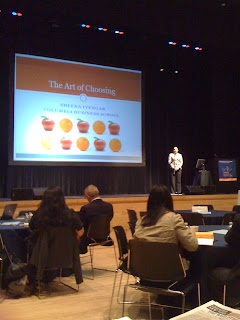
Sheena Iyengar, Columbia Business School professor and author of The Art of Choosing
, discussed choice and how to create a mutually beneficial relationship as a result of the choices we offer customers [i.e., choice for benefit rather than to trick].
[See Sheena Iyengar & the Power of Choice which includes a video.]
Three negative consequences come from too many choices: commitment [it's easier to delay choices], make worse choices [the decision quality decreases] and satisfaction diminishes.
"Our eyes are too big for our mind" as well as our stomach.
The ideal number of choices that our perception and memory can handle: magical #7 +/- 2 [Note: experts can handle more choices in their area of expertise.]
When are we better off when we have more choices? It depends on the level of experience in the choosing domains. A chess master thinks 8 moves ahead and considers an infinite number of options. However, s/he sees the chess board as patterns and can therefore zero in on the best, most relevant options.
Today's marketplace is designed for experts, but we aren't all experts. Here are three techniques to improving the choosing experience:
1. Cut: careful trimming can increase sales and improve profitability. It eliminates redundant options.
2. Categorize. Experts do this; very helpful for novices. Best Cellars does this effectively for wine, grouping them into 8 categories, with more information within each category. Be useful to the chooser, not the creator of the category.
3. Condition for Complexity. Need a methodical approach to having lots of choices. If you start with deep to shallow options, customers are less likely to engage; you lose them. However, if you start with shallow questions and proceed to more involved options, customers are more likely to hang in and satisfaction with their choice increases.
[Culture does play a role in choice because criteria are a function of culture.]
Talk about a lot of valuable insights!
Be sure to check out Brad Jobling's BRITE Conference 2011 Highlights.
Also, Randall Ringer has a fabulous series of posts detailing BRITE 2011:
On the social side, I had the opportunity to meet for the first time in person Frank Eliason, BL Ochman and Denise Lee Yohn and get caught up with David Polinchock, Brad Jobling, Tom Guarriello [you might enjoy Tom Guarriello On Bridging New & Old: Social Media Series] and Anne Mai Bertelsen.
Did you attend or follow BRITE Conference? What were your highlights?
Added 3/16/11: Denise Lee Yohn's Top Tweets From BRITE Conference 0311
Here are my BRITE Conference highlights.
Large corporations are internalizing social principles and marketing differently.
VISA - Antonio Lucio, global chief marketing officer described how, over a two year period, coinciding with the company going public, the company transformed itself to think audience first, guided by social media principles of sharing, participation and recommendation, activated via a combination of paid, owned and shared media.Antonio discussed the new path to customer transactions, from funnel to loyalty loop across many touch points, with an army of advocates.
He described the social media principles as:
- Sharing is the new giving.
- Participation is the new consumption.
- Recommendation is the new advertising.
![]() |
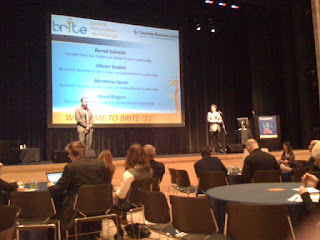
| David Rogers, Schmitt open BRITE Conference '11 |
1. Aired an honest ad: "We listened to our toughest critics; they inspired us to reinvent our pizza from the crust up." Added live Twitter feed to home page; included long form video to further detail the story. Note: used documentary style film maker.
2. Ad based on having focus group participants try the new pizza. Posted the entire video online so viewers could see for themselves that the footage was authentic.
3. Found consumers who had never tried Domino's. Held an online competition to identify Domino's Pizza holdouts [e.g., Scott Schoyer].
4. Show us your pizza invited customers to upload their own photos of Domino's Pizza. This was in contrast to normal product photo practice which had little to do with fresh pizza.
5. Show us your problems. Send photos of poor looking pizza or delivery issues.
6. Where do the ingredients come from? Focus on 100% transparency let to BehindThePizza.com
Critical learnings:
- Listen and do something about what you learn.
- Very important to report back to detractors on changes made. Show response.
- There's nothing to hide.
FedEx - Renee Horne, director digital and social media engagement, explained how, as FedEx has shifted investments from traditional paid media to owned and earned media sources, it has embraced social media most visibly via the IamFedex.com program whereby Fedex employees tell their story.
FedEx has noticed how customers are engaging through social networks and are much more likely to trust conversations taking place on earned sources [i.e., on social platforms]. This is a critical point!
In the 1980s, FedEx relied on broadcast networks to communicate in a linear model. That model has become irrelevant. The new model is about dialog with customers. The role of the marketer has evolved, as has that of company employees. Employees are now brand ambassadors who generate creative ideas [i.e., content] for reaching out to and engaging with customers. Hence, IamFedex.com where 275k FedEx employees from around the world, in a multitude of languages, celebrate their personal stories.
| The VISA loyalty loop |
Power of Purpose in a transparent world [aka radical transparency]
Tim Maleeny from Ogilvy described the Big IdeaL, for brands with a higher purpose focused not on transient share-of-mind ideas, but rather share-of-culture ideals.I loved the contrast Tim made between short term brand campaigns that are advertising focused, front loaded with recurring costs
and
long-term, business focused ongoing behaviors that are cost efficient, redefine the category, drive employee loyalty and epitomize a brand's best self and the existing cultural tension. Examples: Dove addressing that only 2% of women think themselves beautiful, IBM wanting to build a smarter planet, and Coke focusing on bottled happiness. [See Dove - What is Real Beauty?]
Hank Cardello, author of Stuffed: An Insider's Look at Who's (Really) Making America Fat
Carol Cone from Edelman Citizenship shared intense passion for "the power of purpose in a transparent world" and the need for Capitalism to have a human face given the all time low recent Trust Barometer results. 86% of consumers say that business must align performance with social concerns; 62% will switch if a company doesn't. Many corporations are changing their mission to include performance with a purpose.
Having a purpose benefits businesses. It creates a difference; leads to innovation, growth and sales; it builds and protects reputation and it engages customers and employees. Purpose fuels growth and it evolves. To be authentic, though, it's important to pick the issue first, identify credible best partners and then consistently support the issue.
Intense Innovation
Robert Russell, director of mobile marketing solutions with AT&T, described how mobile has passed TV and traditional media on many usability metrics. The smartphone is the equivalent of 1:1 marketing. But, mobile doesn't exist in isolation. It requires related assets - from signage, to web, TV, WiFi and direct mail. The mobile marketing ecosystem includes:- Media: online, billboards, direct mail, point of sale, digital signage, print
- Mechanism: QR code, RFID, location based services, 800#
- Platform: mobile application platform, code management, cloud computing
- Result: information, video, games, coupons
Location based messaging: SMS combined with location becomes more relevant to customers. Imagine having a geofence around stores and, if you've opted in, you can receive relevant messages from retailers when you cross the fence.
Here's a recent article you'll find relevant: Coming Soon: Advertiser alerts on your phone
Luke Williams, author of Disrupt: Think the Unthinkable to Spark Transformation in Your Business
Luke described 2004 research by Richard Nisbitt about how culture affects our thinking. He analysed what students from the West and Asia paid attention to when looking at the same images. The Westerners looked at the foreground whereas the Asians focused on the environment/context. Conclusion: Westerners were change blind suggesting a type of myopia when focused on brand-building and technology [e.g., think Apple].
The need for disruptive innovation becomes critical when brands focus on giving consumers what they expect plus more. At some point - have you tried to simply pick out a tube of toothpaste lately? what do all of those options mean? - nothing stands out for customers. Disruptive innovation isn't about technology; that is myopic. Better to focus instead on behavior revolution [e.g., the Internet aka MP3 generation has a different frame of reference and values for speed, convenience and quality].
Changes in consumer behavior trigger a need for new brand thinking. Look at brand conventions and mix them all up. Break free. See the new. Be unpredictable.
![]() |
| Fedex's marketing evolution |
Steve Rubel, senior vice president, director of insights, Edelman Digital, presented the Eleven Digital Trends to Watch in 2011. I'll cover those in a separate post.
Sheryl Roth Rogers, chief marketing officer of Mom Central Consulting, in a discussion about social commerce, focused on the art of influence and activating moms on behalf of brands. Brands building relations with customers represents a paradigm shift.
Traditional brand building focuses on ROI, targeted impressions and CPM which Sheryl equated to counting frogs and raindrops in the rainforest. Social media marketing focuses on spheres of influence and many small circles of influence coming together, people talking to each other and becoming passionate enthusiasts. Brands need to understand the tapestry of brand engagement associated with social media and social commerce.
Professor Leonard Lee moderated the social commerce discussion which also included Bill Chasen from Stickybits, allowing you to attach digital content to any object using bar codes that can be read using the Stickybits app, and Marissa Evans from GoTryItOn.com, a social retailing website with 100k iPhone users [80% women, 40% global] who upload photos of themselves wearing outfits to get opinions on whether to wear the outfit or not. He made the following observations:
- Social commerce is here to stay.
- If done properly, it's effective to sell with a social approach.
- It's critical to be customer focused particularly in executing the product experience.
- It's an iterative process.
- It's important to integrate across all customer touch points.
- Meet consumers' needs
- Tailor the experience into snack bites depending on how customers consume information.
- Be ready for increased levels of transparency.
He sees his role within Citi as trying to be disruptive in reminding people about the customer perspective. The customer controls the message; we all read reviews written by other customers before buying. Bad conversations happen; it's better to know about them so you can do something about them.
Customer service is the new PR and the new marketing. It's about person to person interaction with customers.
Josh Millrod/Jason Clement from Weiden + Kennedy [whose mission is "to create strong and provocative relationships between good companies"] described how to socialize brands and activate digital communities. Mind you, they are behind Old Spice and Isaiah Mustafa.
Socializing is the antithesis of traditional advertisting: "you can't socialize with 1 million people at once."
Furthermore, "scale isn't always achieved by creating something that appeals to the largest number of people" [I find this concept fascinating].
Examples include Wheat Thins pallet, Lufthansa Beer Garden and Lil B "cooking dance". Old Spice represents a traditional advertising concept. The challenge was figuring out how to make it more social. Solution: have Mustafa respond to individuals!
On finding ways to scale 1:1 conversations:
- Don't rely on an army of interns.
- Appeal to the masses by creating for a few.
- Inspire others to host the conversation for the brand.
- This requires that you find what the truth is about your brand.
![]() |
| Iyengar: The Art of Choosing |
[See Sheena Iyengar & the Power of Choice which includes a video.]
Three negative consequences come from too many choices: commitment [it's easier to delay choices], make worse choices [the decision quality decreases] and satisfaction diminishes.
"Our eyes are too big for our mind" as well as our stomach.
The ideal number of choices that our perception and memory can handle: magical #7 +/- 2 [Note: experts can handle more choices in their area of expertise.]
When are we better off when we have more choices? It depends on the level of experience in the choosing domains. A chess master thinks 8 moves ahead and considers an infinite number of options. However, s/he sees the chess board as patterns and can therefore zero in on the best, most relevant options.
Today's marketplace is designed for experts, but we aren't all experts. Here are three techniques to improving the choosing experience:
1. Cut: careful trimming can increase sales and improve profitability. It eliminates redundant options.
2. Categorize. Experts do this; very helpful for novices. Best Cellars does this effectively for wine, grouping them into 8 categories, with more information within each category. Be useful to the chooser, not the creator of the category.
3. Condition for Complexity. Need a methodical approach to having lots of choices. If you start with deep to shallow options, customers are less likely to engage; you lose them. However, if you start with shallow questions and proceed to more involved options, customers are more likely to hang in and satisfaction with their choice increases.
[Culture does play a role in choice because criteria are a function of culture.]
Talk about a lot of valuable insights!
Be sure to check out Brad Jobling's BRITE Conference 2011 Highlights.
Also, Randall Ringer has a fabulous series of posts detailing BRITE 2011:
- It will be BRITE later
- BRITE early
- Too BRITE – or – back to the office I go!
- When We Were BRITE And Young…
On the social side, I had the opportunity to meet for the first time in person Frank Eliason, BL Ochman and Denise Lee Yohn and get caught up with David Polinchock, Brad Jobling, Tom Guarriello [you might enjoy Tom Guarriello On Bridging New & Old: Social Media Series] and Anne Mai Bertelsen.
Did you attend or follow BRITE Conference? What were your highlights?
Added 3/16/11: Denise Lee Yohn's Top Tweets From BRITE Conference 0311
Thursday, March 3, 2011
Press Release: Concerned About Managing Your Company's Reputation in a Social World?
For Immediate Release: March 1, 2011
Kinnelon, NJ – MarketingProfs presents “Managing Your Reputation in a Social World” to explore how to make the most out of digital customer interactions. The online seminar, led by Christine B. Whittemore, chief simplifier of Simple Marketing Now LLC, takes place March 10, 2011 from 12pm to 1:30pm EST.
“Many businesses fear entering into social and digital conversations with potential customers and miss out on opportunities to connect with customers online, obtain feedback from them and develop long term relationships,” says Whittemore. “This session will explore the benefits associated with engaging in social media marketing and outline best practices so businesses can make the most of customer interactions and pro-actively manage their reputation given the digital social world we live in.”
Whittemore has been immersed in social media since 2006 – personally, for a brand and for her business. She is the author of Flooring The Consumer – a highly acclaimed weblog about the customer retail experience and marketing to women and an AdAge Power 150 Marketing Blog. She also writes the Simple Marketing Blog, a Junta42 Top 42 Content Marketing Blog and contributes to MarketingProfs.
To attend the March 10th MarketingProfs online seminar “Managing Your Reputation in a Social World”, register by visiting http://www.marketingprofs.com/marketing/online-seminars/346. The event is free for MarketingProfs Pro members and $129 for non members.
For information about Simple Marketing Now, visit http://SimpleMarketingNow.com. Or, simply contact Whittemore at cbwhittemore@SimpleMarketingNow.com.
# # #
About Simple Marketing Now LLC
Simple Marketing Now, a marketing communications consultancy, helps organizations integrate social media and content marketing with traditional marketing to better connect with customers and improve business profitability.
Simple Marketing Now issues the Social Flooring Index which monitors the social state of the Flooring Industry and Flooring The Consumer about marketing to women and the retail experience.
For more information, visit http://SimpleMarketingNow.com.
About MarketingProfs
MarketingProfs is a rich and trusted resource that offers actionable know-how to help you market your products and services both smarter and better. Entrepreneurs, small-business owners and marketers in the world’s largest corporations make up its383,000 subscribers, making it the largest in its category. Through the MarketingProfs Web site, newsletters, conferences, seminars, forums and so on… we help you navigate your way to market your business and keep you informed of the newest and best tools. Think of us as a beacon of light illuminating the path through the clutter.
For more information, visit http://www.marketingprofs.com/.
Concerned About How To Manage Your Company’s Reputation in a Social World?
MarketingProfs Online Seminar Shares Valuable Insights
Kinnelon, NJ – MarketingProfs presents “Managing Your Reputation in a Social World” to explore how to make the most out of digital customer interactions. The online seminar, led by Christine B. Whittemore, chief simplifier of Simple Marketing Now LLC, takes place March 10, 2011 from 12pm to 1:30pm EST.
“Many businesses fear entering into social and digital conversations with potential customers and miss out on opportunities to connect with customers online, obtain feedback from them and develop long term relationships,” says Whittemore. “This session will explore the benefits associated with engaging in social media marketing and outline best practices so businesses can make the most of customer interactions and pro-actively manage their reputation given the digital social world we live in.”
Whittemore has been immersed in social media since 2006 – personally, for a brand and for her business. She is the author of Flooring The Consumer – a highly acclaimed weblog about the customer retail experience and marketing to women and an AdAge Power 150 Marketing Blog. She also writes the Simple Marketing Blog, a Junta42 Top 42 Content Marketing Blog and contributes to MarketingProfs.
To attend the March 10th MarketingProfs online seminar “Managing Your Reputation in a Social World”, register by visiting http://www.marketingprofs.com/marketing/online-seminars/346. The event is free for MarketingProfs Pro members and $129 for non members.
For information about Simple Marketing Now, visit http://SimpleMarketingNow.com. Or, simply contact Whittemore at cbwhittemore@SimpleMarketingNow.com.
# # #
About Simple Marketing Now LLC
Simple Marketing Now, a marketing communications consultancy, helps organizations integrate social media and content marketing with traditional marketing to better connect with customers and improve business profitability.
Simple Marketing Now issues the Social Flooring Index which monitors the social state of the Flooring Industry and Flooring The Consumer about marketing to women and the retail experience.
For more information, visit http://SimpleMarketingNow.com.
About MarketingProfs
MarketingProfs is a rich and trusted resource that offers actionable know-how to help you market your products and services both smarter and better. Entrepreneurs, small-business owners and marketers in the world’s largest corporations make up its383,000 subscribers, making it the largest in its category. Through the MarketingProfs Web site, newsletters, conferences, seminars, forums and so on… we help you navigate your way to market your business and keep you informed of the newest and best tools. Think of us as a beacon of light illuminating the path through the clutter.
For more information, visit http://www.marketingprofs.com/.
Tuesday, March 1, 2011
Practical Simple Marketing In The News - 3/1/11
Happy March! In honor of the snow melting in Northern New Jersey and Spring officially springing in just a few weeks, I have a special treat for you! A record number of marvelous links and resources shared on Twitter and tagged #practicalmktr grouped here together in Practical Simple Marketing In The News.
[If you are interesting in the retail experience, I've been doing something similar on Flooring The Consumer with Retail Experience links #retailexp.]
Here goes...
Facebook
Thank you for reading!
Best,
C.B.
Image credit: “#PracticalMktr” Wordle by CB Whittemore
[If you are interesting in the retail experience, I've been doing something similar on Flooring The Consumer with Retail Experience links #retailexp.]
Here goes...
Simple & Practical Marketing Data
- Edelman's 11 digital trends to watch in 2011 fr @steverubel @armano http://ow.ly/3ATef #practicalmktr
- Stats about how users use search engines http://ow.ly/3FvKh #practicalmktr
- From @pixability online video grader http://ow.ly/3GWVd #practicalmktr
- This is pretty wild: FC Iinfographic of Day map your linkedIn network http://bit.ly/hcCyoZ #practicalmktr
- 10 Business Models that Rocked 2010. Amazing the range of innovation! http://ow.ly/3QZUF #practicalmktr
- 16 social media stats that might surprise you fr @arikhanson http://ow.ly/3RjmH #practicalmktr
- 10 top twitter analytic tools fr @adamvincenzini http://ow.ly/3Rjvj #practicalmktr
- Comscore's 2010 US digital year in review. Link for whitepaper http://ow.ly/3U0cW #practicalmktr
- Changing social media metrics acc to emarketer: http://ow.ly/3TTaY Wh d U find best? #practicalmktr
- Twitter's impact on social media & real-time communication http://ow.ly/3TUBS #practicalmktr
- Lots good social media insights in burson-marstellar 2nd annual survey of Fortune 100 cos http://ow.ly/4004N #practicalmktr
Practical Marketing Advice
Customers and Reputation Online
- Make social part of company culture; listen & love customers http://ow.ly/3CWXN #practicalmktr & #retailexp
- Reputation management, the unwritten laws - http://ow.ly/3FuYW What wld U add? #practicalmktr
- H2 deal w social media crises fr @JayBaer @AmberCadabra http://ow.ly/3Viet #practicalmktr
- 6 things U nd 2 know about social listening fr AdAge http://ow.ly/3ViGK #practicalmktr
- Why U want/need negative blog comments fr @ariherzog http://ow.ly/3VnsG #practicalmktr
- How clever: http://ow.ly/4009J Amazing & brave way to handle negative yelp review #practicalmktr
- Managing Blogger Outreach: tips fr @LivePath http://ow.ly/400Ci #practicalmktr
- 10 laws of social media marketing http://ow.ly/4015t #practicalmktr
- From community management to command center - fr @BrianSolis http://ow.ly/3MVRS Intense extremes #practicalmktr
- Why competitors aren't blogging: 5 reasons http://ow.ly/3Rjkl #practicalmktr
Time Management
- Amen to this! what U can do today to prevent social media overload http://ow.ly/3Fv1I #practicalmktr
- Tips on H2 manage time: http://ow.ly/4007T [note title: simple!] I like color-coding w/highlighters #practicalmktr
- More tips on h2 manage time: http://ow.ly/4013b Common theme: unplug, avoid interruptions #practicalmktr
Measurement
- Social Media Analytics: 6 steps to measuring what you care about fr @shashib http://ow.ly/3IskM Gr8 #practicalmktr advice
- From the marvelous @kdpaine, 7 techniques for measuring your social media efforts http://ow.ly/3Up5m #practicalmktr
- This post re influence in PR & Social Media by @shonali is totally relevant: http://ow.ly/3RgwH #practicalmktr
Quora
- Curious about Quora? 9 ways 2 get more of it http://ow.ly/3QYIi #practicalmktr
- Quora: what it is and how 2 use it: http://ow.ly/3Rgdp What wld u add? #practicalmktr
- Getting more out of Quora: 9 ways fr Mashable http://ow.ly/3VfLd #practicalmktr
- Appreciating Quora from a design perspective http://ow.ly/42llC #practicalmktr
Content
- Lovely ideas for blog content in this @OpenForum Post: http://ow.ly/3RgqY #practicalmktr
- Best of both worlds? Integrating social media and SEO fr ClickZ http://ow.ly/3VfQP #practicalmktr
- Trade show booths are about relationships tb built in booth. Talk about #practicalmktr advice on #MprofsPRO from @TheBeanCast
- Leveraging Facebook's news feed algorithm http://ow.ly/3TZYB - 2B digested! #practicalmktr
- NYT on h2 groom yr New Facebook Fan Page: http://ow.ly/3VhZw #practicalmktr
- Facebook Fan Page cheat sheet: http://ow.ly/3Vi31 #practicalmktr
- Which of these 6 keys to boost facebook engagement have you tried? http://ow.ly/3NL7Q fr @EllieBehling #practicalmktr
- Possibly the holy grail, it's easy to 'like'; how do you engage fans consistently on FB? http://ow.ly/42lzk #practicalmktr
Simple Marketing Inspiration
- Love this advice about power of touch and h2 make most of social media engagement http://ow.ly/3AT6J #practicalmktr
- It's about listening & engaging says @adamboettiger http://ow.ly/3CfgZ via @kathleary #practicalmktr
- Gr8 examples! RT @DanielBurstein: Real-time Marketing: Don't complain about the weather, put it to work http://bit.ly/fDJSV9 #practicalmktr
- How many of U do this every day? It's about learning http://ow.ly/3FuSR #practicalmktr
- Fabulous Twitter insights fr @biggayicecream http://ow.ly/3FvoD #practicalmktr #retailexp
- @gianandrea TU for that critical reminder. Reminded me of @DaveCarroll "no customer is statistically insignificant anymore" #practicalmktr | RT @gianandrea: @CBWhittemore One single voice counts: do not neglect anyone commenting about you. #practicalmktr
- This is Twitter poetry! fr @jayrosen_nyu http://ow.ly/3FvGo @PegMulligan - you will enjoy this! #practicalmktr
- Really enjoy @fgossieaux presentation on Human1.0 "Is yr brand powered by people?" http://ow.ly/3X5Wn #practicalmktr
- What a fabulous use for social media: helping pets be adopted http://ow.ly/3ZtVl #practicalmktr
- Brilliant interview fr @LivePath on @MarketingProfs re: what U can learn fr unofficial bloggers http://ow.ly/400np #practicalmktr
- Lovely inspiration: 10 mindful ways to use social media fr @TinyBuddha http://ow.ly/400Mj #practicalmktr
Brands Being Practical With Social Media
- 12 ways to keep creating like Coldplay - gr8 insights http://ow.ly/3MVwE #practicalmktr
- The New Rules for Branding your biz online fr Inc. Mag: http://ow.ly/3MVO3 #practicalmktr
- Terrific insights from National Wildlife Federation @starfocus on using social media http://ow.ly/3NMJg #practicalmktr
- Delicious insights fr @BethLaPierre Kodak Chief Listening Officer http://ow.ly/3U1kS #practicalmktr
- Have U seen Orabrush on YouTube? http://ow.ly/400HL Per WSJ, social media = reason for stardom http://ow.ly/400IX #practicalmktr
- Social media & government: tapping quora for eDemocracy experiment http://ow.ly/42lij #practicalmktr
- Publishing without publishers aka the Magalog fr NYT http://ow.ly/3Ix5u #practicalmktr cc @magalogguy
- I love the idea of Aunt Jemima embracing social media & using employees http://ow.ly/42ltc Just wish it weren't a campaign #practicalmktr
Thank you for reading!
Best,
C.B.
Image credit: “#PracticalMktr” Wordle by CB Whittemore
Subscribe to:
Posts (Atom)